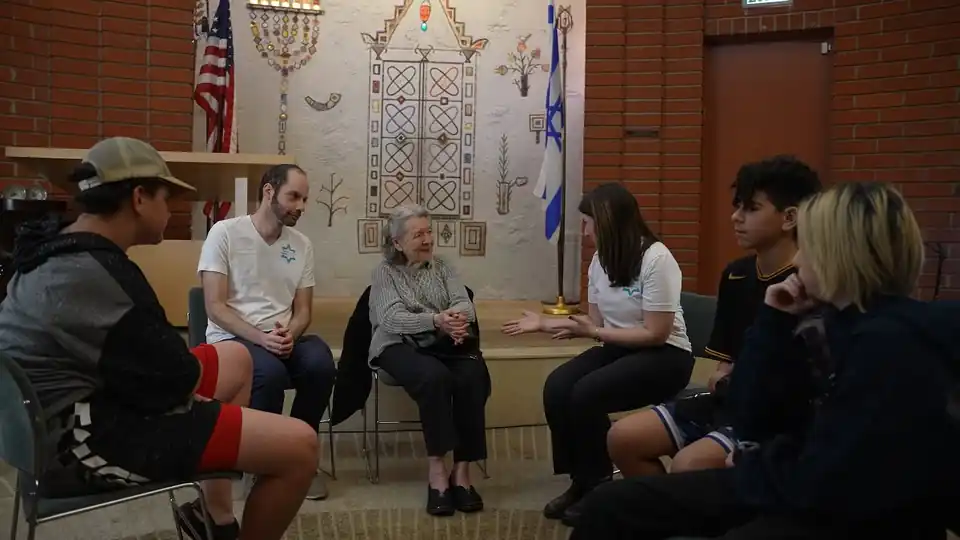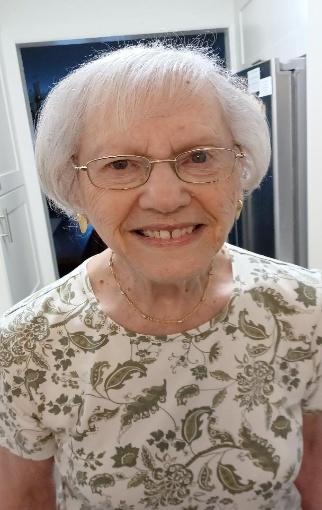
Marianne Aaron was eight years old on November 10, 1938, when the main synagogue of Mannheim, Germany, where her father, Cantor Hugo Ch. Adler, served as head cantor, was destroyed.
Marianne is the mother of Rabbi Jonathan Aaron, Temple Emanuel’s senior rabbi. She wrote this remembrance for the ChaiVillageLA newsletter.
Her Story
Hello, I am Marianne Aaron. My claim to fame in L.A. is that I am Rabbi Jonathan Aaron’s Mom! I recently moved here at the beginning of July 2026 from Ann Arbor, via: Cleveland; Boston; West Hartford; NY; Worcester, MA; and originally from Mannheim, Germany.
I was born in Germany in 1930, just three years before Hitler came to power. Two-and-a-half years earlier, my brother, Samuel, was born. My father, Hugo Adler, was the Head Cantor (of four) at the Hauptsynagogue (“main synagogue”). This synagogue was considered “Liberal,” although I would call it “Orthodox,” except for the fact that music played an important role and there was an organ and a mixed-gender choir. My mother, Selma Rothschild Adler, was a member of that choir.
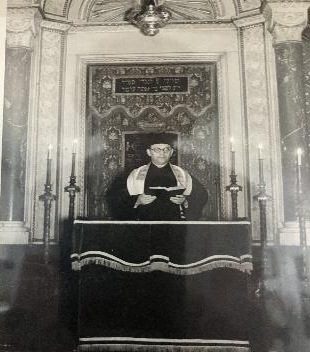
Our life revolved totally around the synagogue. My first recollection as a four-year-old was spending the week of Sukkot in the nursery school’s sukkah.
The reason that I would call us “Orthodox” is because women sat separately at services, we were strictly Kosher and “shomer Shabbos,” which meant tearing toilet paper before Friday night, and my mother never carried a pocketbook on Shabbat. On Shabbat, we would attend services, go to my grandparents’ nearby home for lunch, take walks, and play games (as long as the games didn’t involve having to write anything down).
My parents did everything they could to create a happy childhood for us. Our maternal grandparents, who lived nearby, would take us for excursions to Heidelberg every weekend that weather allowed. We would wander in the woods, always shielded from the world outside.
We had a maid, Anna, who lived with us, and I was more attached to her than to my own mother, even going with her on days off, when she went to visit her family at a nearby farm. In 1935, the Nuremberg Laws were introduced, and no Christian woman was allowed to work for Jews when there was a man in the household. So, my beloved Anna left us to work for a widow.
We knew what we were and were not allowed to do, and this was part of everyday life. We were required to attend only Jewish schools; weren’t allowed into movie theaters, restaurants, or public swimming pools; and if we saw anyone in a uniform, we quickly crossed the street. We still had our Jewish friends, rode our bikes, and personally weren’t so affected as families where the men lost their jobs because they were Jewish.
Many in my father’s congregation left for Israel or the United States. The Senior Rabbi encouraged my father to do the same. It wasn’t until the Senior Rabbi also left that my father looked into leaving.
In the spring of 1938, my grandparents applied for an exit visa. My grandmother’s brother, who had come to the U.S. before WWI and who was a quite successful pants manufacturer in NYC, had provided affidavits for his five siblings and their families.
My grandparents were told that the U.S. immigration quota for accepting Germans was filled. However, because my father’s application showed he had been born in Antwerp, Belgium, where his parents lived for just a few years before returning to Germany, our family came under the Belgium quota, which was open.
My parents made all the arrangements to leave, securing a lift van so that we could transport our furniture and obtaining tickets on the SS Manhattan. The only thing left to do before leaving was to be examined by a doctor at the American Embassy in Stuttgart. The four of us went by train to Stuttgart at the end of October. As we left the station, a cinder fell into my mother’s eye and she rubbed it. By the time she saw the doctor, her eye was quite red and although she explained what had happened, he decided that she probably had an eye disease, which would prevent her from coming to the U.S. The doctor told her, “Get examined by an ophthalmologist and report back here in a month.” My father, brother Sam, and I were given the papers that we were eligible to leave, but not my mother. Of course, within a few days, my mother’s eye cleared perfectly, but before she could return to Stuttgart came November 10, 1938!
We had one phone at our apartment and it rang at 6 a.m. the morning of November 10 with someone telling my father that our precious synagogue had been dynamited during the night and that my father should go there to make sure that no children had showed up for the day school. My father took 10-year-old Sam with him—probably so that if he ran into trouble, Sam could come back to tell us. They did encounter trouble when they almost made it to the ruins of the synagogue, and a former teacher colleague of my father spotted him and yelled, “There’s one of them.” Luckily my father and brother escaped, hid in a friend’s home, and finally came back home.
My parents believed that only men were being rounded up and, since my father had papers, that he should go to Holland. After some bribery to get things in order, my father left. We were terrified at home because we heard of all the horror stories about SS troops coming into homes and throwing furniture out of windows. An 11-year-old friend of Sam’s was forced to play his violin while they beat up his father and then they took the violin and threw it out the window. We were not touched.
We did not hear from my father for several days, but we knew that he didn’t make it to Holland, since he would have called us. At the border, everyone who had a “J” in their passport had to leave the train. They were put into the local jail. After several days of detaining hundreds of people in this little town, the mayor decided that he couldn’t afford to feed or house them and sent everyone home.
A day after my father returned home, he felt that he wanted to check out if there was any sheet music left that wasn’t destroyed in the synagogue fire. He again took my brother Sam with him. They saw that there was a fully armed guard at the entrance. My father knew of a rear staircase that led up to the choir loft and, indeed, there were a few remnants of sheet music left.
At that time, because of all the dust that was around, Sam sneezed! “Who’s there?” the guard demanded.
Just as he said that, the organ, which had been hanging by a cable, smashed to the ground! The guard ran for his life and my father and brother did the same, down that remote staircase. Shortly after that, with all the right papers, my father made it out of Germany into the Netherlands.
My mother went back to Stuttgart and this time she passed her physical, got her papers, and returned home. She was walking up the steps to our second-floor apartment, when our new neighbor followed behind her and called her by name. My mother tried to get into the apartment quickly, but this woman stopped her to tell her, “My husband is the head of SS in Mannheim, and he gave strict orders that no one was to enter our house on Kristallnacht, so you didn’t have to worry.” My mother thanked her and, shaking, quickly closed the door. So that explained why we were not raided like others on that day. My father would have been safer just staying at home. But who knew?
At the end of December, my mother, Sam, and I, with lots of suitcases, left for Amsterdam to meet my father. Since we had so much baggage, my grandfather went halfway along to help us since we had to change trains in Frankfurt. It was a tearful farewell from my beloved Opa, not knowing if we would ever meet again.
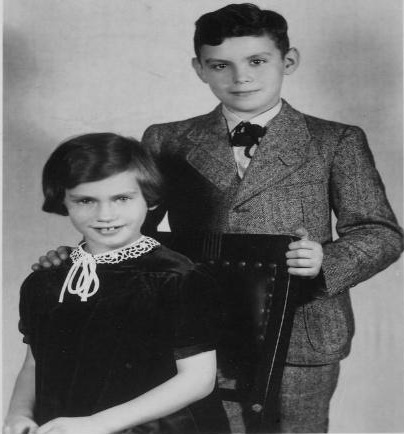
We settled into our seats when, at the Dutch border, the Germans were able to shake us up one last time. “Everyone with a ‘J’ off the train with your luggage because I’m not sure when you can get back on.” Unfortunately, “roller” suitcases had not yet been invented, so the three of us had to schlep everything we had off the train. We stood in a long line and when it finally came our turn, they just stamped our papers and said to get back on the train. At this point, my mother was shaking and terrified 8-year-old me was crying. My mother’s trembling hand let our papers fall under the train and Sam got down on his stomach to retrieve them.
Finally, we were actually on our way to freedom.
We stayed with an uncle in Amsterdam for a week, then a week in London, and, on January 17, 1939, my father’s birthday, we left Europe on the SS Manhattan and landed in NYC on January 24, my grandfather’s birthday.
Fortunately, a few years later, my grandparents were able to get to London in 1941 and eventually made it to the U.S., crossing in mined waters.
With all the trauma, we still were the fortunate ones to escape the horrors that were to come. It is especially at this time of the year that I remember this story so vividly and thank God for the unusual circumstances and mazel that kept our immediate family from becoming a statistic.
Many in our family were not as fortunate and I remember them with love.
Thank you for letting me share this story with you. I hope to share more positive and happy stories at a future time.
A Brother’s Memory
Marianne’s brother, the composer Dr. Samuel H. Adler, was ten years old in November 1938. In the short documentary One Story of Millions, he gives his own firsthand account of Kristallnacht in Mannheim, of the music books he and his father carried out of the ruined synagogue, and of what became of those books more than eighty years later. The film premiered at Temple Emanuel’s Simply Shabbat service on January 28, 2022.
One Story of Millions: The Incredible Story of Dr. Samuel H. Adler (6:47). Temple Emanuel of Beverly Hills.
Keeping Their Stories Alive
At Temple Emanuel, remembrance is more than looking back. Through our Religious School’s Holocaust remembrance program, students have the opportunity to hear survivors’ stories firsthand and share those experiences with our community. In doing so, they help ensure these voices continue to be heard by future generations.